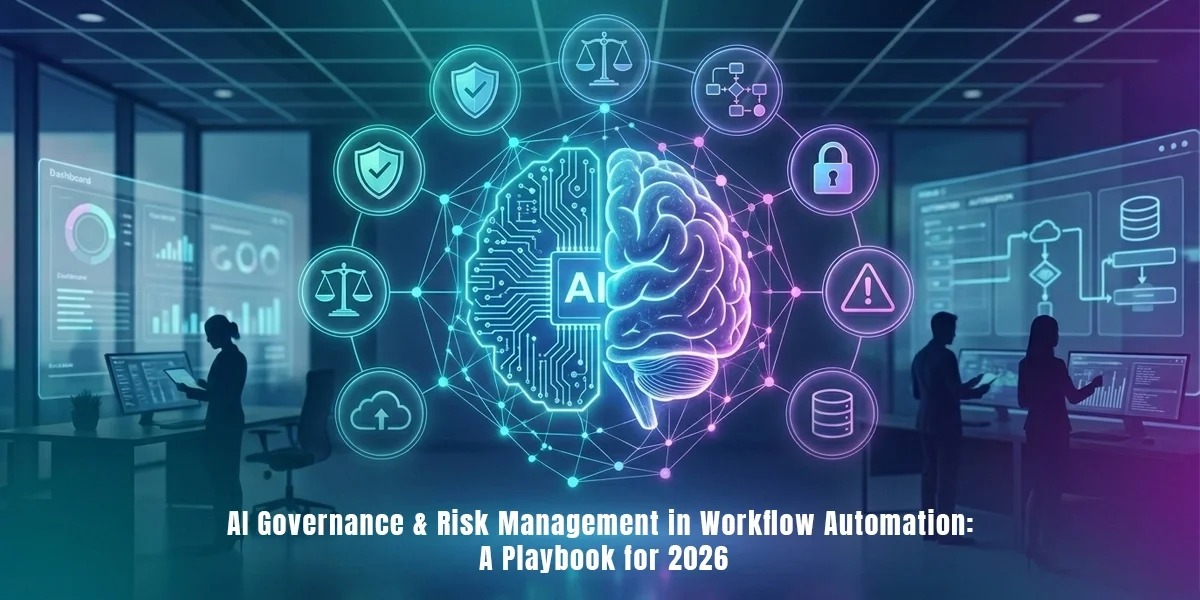
Large language models, decision intelligence systems, and autonomous process orchestration engines are driving a structural transformation in enterprise workflow automation. Analysts project that more than 65 percent of enterprise workflows will incorporate AI-driven decision components by 2026, compared to less than 30 percent in 2022.
At the same time, global AI regulation is accelerating. The EU AI Act introduces binding risk classifications, documentation obligations, and post-deployment monitoring requirements, while jurisdictions across Asia-Pacific and North America are formalizing algorithmic accountability provisions.
This convergence of scale and regulation makes structured implementation of an AI governance framework a strategic mandate rather than a compliance exercise. Organizations deploying AI-driven workflow automation without embedded governance controls accumulate exponential operational, regulatory, and reputational risks.
A robust enterprise AI risk management strategy in 2026 must operate as an integrated control architecture spanning model lifecycle management, data pipelines, decision orchestration, and human oversight mechanisms.
Defining AI Governance in Workflow Automation
Operational Definition of an AI Governance Framework
An AI governance framework is an organized control mechanism, which spells out policies, procedures, responsibility models, and technical protection of AI-supported decision systems throughout their lifecycle.
In workflow automation, governance spans:
- Data ingestion and preprocessing pipelines
- Model development and validation cycles
- Decision orchestration engines
- Downstream automation and API integrations
- Continuous monitoring and retraining loops
Governance ensures that automated workflows operate within defined risk thresholds, regulatory boundaries, and performance standards.
Governance vs. Compliance
Compliance is regulation-specific and reactive. Governance is proactive and system-wide.
Compliance ascertains the conformity to the outside requirements like classification of risk, documentation and disclosure requirements. Governance determines the design of AI systems, deployment, monitoring, and decommissioning of AI systems in enterprise control frameworks.
A commercial-level AI governance model does not have compliance as its core goal but only as an output of the many.
Enterprise AI Risk Landscape
AI-powered workflow automation amplifies risk exposure due to scale and autonomy. Risk categories that will be applicable in 2026 are multidimensional.
Model Risk
- Drift in a model through changing distributions of data.
- Hallucinations in generative AI systems.
- Automated decision flow bias amplification.
- Unstable outputs in a hostile environment.
Unmonitored model drift in automated workflows can propagate erroneous decisions across thousands of transactions before detection.
Data Privacy and Data Residency Risk
Cross-border data flows are common in automated systems. The regulatory regimes have stringent data residency and consent management requirements. Data lineage traceability is a compulsory requirement of high-risk AI systems in new regulatory standards.
Operational Cascade Risk
Chain of dependency is introduced by workflow automation. In a fraud detection model, the misclassification event can lead to the automated suspension of the account, a regulatory report, and communication with customers. All these cascade effects increase systemic exposure.
Cybersecurity Exposure
Artificial intelligence increases the area of attack:
- Prompt injection attacks
- Data poisoning
- Model inversion risks
- Unauthorized API manipulation.
The AI governance should have security controls built within it.
Reputational Risk and Regulatory Risk
Algorithmic decision-making accountability requirements are expanding. Organizations that cannot deliver explainability artifacts or risk documentation are fined and suffer a bad reputation.
A good enterprise AI risk management program solves all these risks in a unified manner.
Architecture of an Enterprise AI Governance Framework
An effective enterprise AI governance should be designed, reproducible and scalable. It will need a layered architectural design with several control layers:
- Policy Layer: It specifies the enterprise AI principles, ethical policies, policy of data usage, and the levels of risk tolerance. It determines the organizational stance regarding the adoption of AI.
- Model Validation Layer: The layer of Model validation provides strict pre-deployment validation, performance testing, bias, robustness, and stability testing against standardized tests.
- Risk Scoring Systems: This is a standardized way of classifying AI use cases according to impact and probability of risk, what degree of scrutiny and control is needed (e.g. low-risk vs. high-risk/unacceptable risk categories).
- Auditability Infrastructure and Explainability Infrastructure: Provides a clear recording of all modeled decisions and the reason (feature importance) behind automated results, which is highly auditable to perform a full forensic assessment and regulatory audit.
- Continuous Monitoring Systems: Facilitates real-time tracking of model performance, input data quality, and drift detection to trigger alerts or automatic remediation before significant degradation occurs.
- Human-in-the-Loop (HITL) Controls: High-stakes decisions within automated workflows must incorporate structured human review and intervention mechanisms to ensure accountability and risk containment.
2026 Enterprise AI Risk Management Strategy
Risk Classification Matrices
Risk matrices identify AI workflows as:
- Minimal risk
- Limited risk
- High risk
- Prohibited use cases
The documentation, testing, and monitoring requirements are set using classification.
Governance Operating Model
A mature governance operating model defines:
- Chief AI Risk Officer or similar position of supervision.
- Multi-functional AI risk committees.
- Clear escalation protocols
- Periodic board reporting
The authority of governance should be formal instead of being distributed informally among the technical teams.
MLOps + GRC Integration
MLOps pipelines should be connected with Governance, Risk and Compliance (GRC) systems:
- Automated documentation capture.
- Deployment gating controls
- The generation of compliance artifacts.
- Logging of incident integration.
Integration minimizes manual overheads and boosts the preparedness of audits.
Real-Time Dashboards of Compliance
The key performance indicators monitored are:
- Risk scores by model
- Drift metrics
- Policy violations
- Incident status
Dashboards give the executives an overview of the risk exposure of enterprise AI.
Metrics & Controls
The operational component of any AI governance framework is based on quantifiable metrics and granular controls. Key elements include:
- Model Performance Thresholds: Performance benchmarks (e.g., accuracy, precision, F1-score) that are pre-defined and quantified (e.g., based on the use case) and have to be achieved to deploy the model and continue its operation.
- Drift Detection KPIs: To monitor data drift (quantified by numerical values such as Population Stability Index) and concept drift (performance variation with time) to cause model retraining or replacement.
- Bias Monitoring Indicators: Standardized measures (e.g., disparate impact, equalized odds) that aim to estimate and quantify systemic bias in input data or predictions made by a model between demographic or other relevant groups.
- Incident Response Protocols: Well-established protocols and SLAs to not only identify, escalate, mitigate, and document AI related events or anomalies in automated processes.
- Governance Maturity Assessment Models: The models to periodically review and compare the maturity of the organization enterprise AI risk management practices with industry standards and best practices.
Implementation Blueprint
Implementation of a complex AI governance model has to take place in a systematic, gradual outline:
- Gradual Implementation: Adopt governance in small steps beginning with a pilot phase that addresses low complexity, visible automated workflows and expands the implementation across the whole enterprise.
- Cross-functional Alignment: It is necessary to make sure that there is active participation and collective responsibility in the business, legal, IT, data science, and risk management functions among the stakeholders.
- Technical Stack Implications: Invest in enterprise-level AI governance systems, ModelOps tools, and explanation systems. Focus more on interoperability across monitoring systems and core engines of workflow automation.
- Vendor Risk Evaluation: Properly perform due diligence and risk assessment of all external AI models and third party automation elements with the requirements to adhere to internal governance framework and security provisions.
- Automation Governance Roadmap Scaling: Establish a vision to gradually widen governance controls and monitoring progressively to more and more models and wider automated process areas throughout the whole organization.
Strategic Conclusion
By 2026, enterprise operational competitiveness will be defined by AI-driven workflow automation. Uncontrolled scale, however, brings about systemic risks. An institutionalized AI governance system is infrastructure, like security infrastructures or financial controls.
Enterprise AI risk management is not a defensive process; it is a strategic process. Companies that have well established governance systems will speed up the adoption of AI, lower regulatory pressure, and generate better trust among stakeholders.
Governance must be positioned as an innovation enabler. Organizations that institutionalize governance at an architectural level will make regulatory complexity their competitive edge and maintain automation-based growth at scale.
You Might Also Like