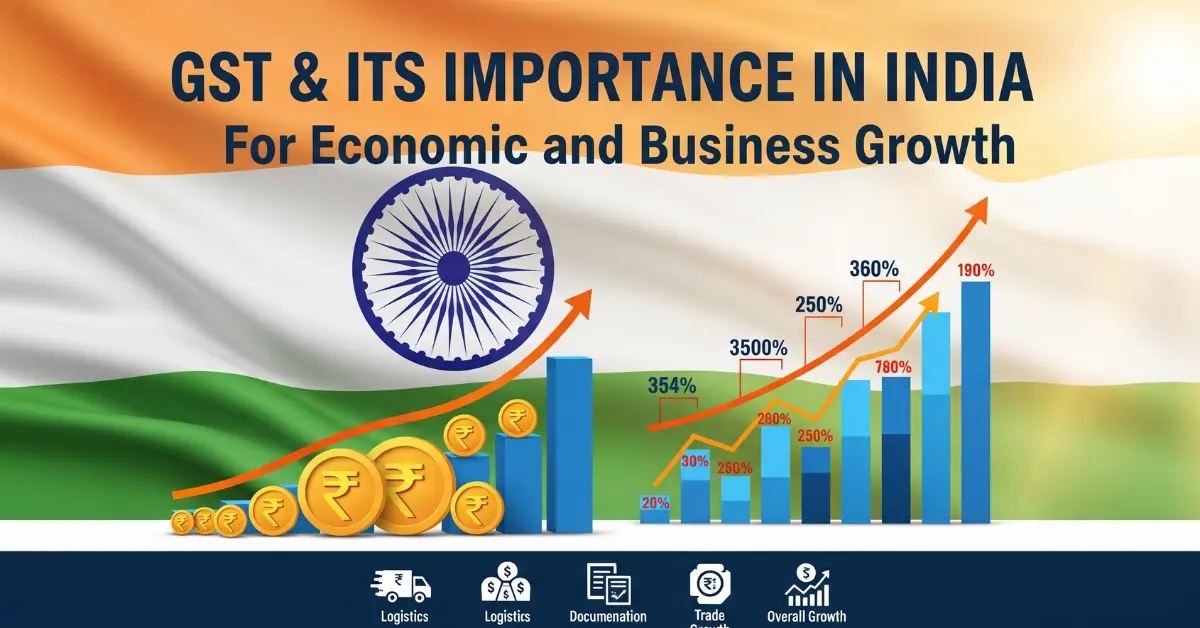
When this tax system was introduced in India, everyone saw it with much suspicion and confusion. Neither could they understand the need nor could they comprehend the system itself. All they had were so many questions around it, and they could gather only misconceptions about the change in our tax system. Nowadays, GST might be a common word for us, but still, not everyone understands the importance of GST in India. So, what is GST, and why do we need this tax system for the country’s economic and business growth? Goods and Services Tax is not an elitist term for the same old tax system we had. In fact, GST (launched in 2017) replaced 17 indirect old taxes with a unified system. As we know that before GST, there were several other taxes businesses had to pay, such as central VAT, service tax, and excise duty. Therefore, it not only negated these multiple-layered systems of taxes but also simplified them in a unified way.
Let Bizzvaultz show you why GST is important for India’s economic and business growth!
What is GST?
GST is a ‘Unified Tax System’ that negates extras! The Goods and Services Tax or GST changed the older tax system. Before GST, every product and service included multiple taxes on them, such as excise, service tax, VAT, CST, octroi, and state entry tax. In a way, it is often taxing the same value again and again. This means if a company has been selling in five states, it has to deal with five sets of rules, forms, and hidden costs or taxes.
GST made it easier for businesses as it replaced most of these taxes with one unified tax system and one set of rules, with input tax credit. Hence, businesses pay tax only on their own value addition, not on the entire chain. This way, GST not only enhanced the clarity of taxes but also made them simpler than ever. Which is why we all need to understand the importance of GST for businesses in India even more. Let Bizzvaultz show you!
The Unified System
As we discussed earlier, India had an indirect tax structure before GST. It included multiple-layered tax on tax system or many individual taxes for different things such as excise, VAT, entry tax, octroi and multiple cesses. Along with these taxes, each state in India had its own set of rules and hence, taxes used to be varied for each state. This means not only was India’s tax system much more complex, but also was a pretty much a fragmented regime. To save the state taxes, businesses or companies had to modify their supply chains around these tax arbitrage and were even forced to have multiple warehouses in different states to save taxes. Hence, importance of GST is natural here for business growth because it makes it easier for businesses to negate all these taxes with a simple, unified tax. Also, the system itself has become more transparent and applies uniformly across all Indian states. All major policy decisions and rate amendments are governed by the GST Council, ensuring a collaborative federal structure.”
What Are the Benefits of GST?
The unified tax system GST, means a simpler, clearer and single common market. But how does unifying the taxes help businesses and boost economic growth? Let Bizzvaultz show you the benefits and importance of GST in India!
-
GST Directly Supports Economic Growth
It is supporting economic growth in a direct way. It means when GST revenue grows, GDP grows along with it. Let us define the importance of GST in a better way! Goods and Services Tax removes tax duplication and simplifies interstate trade for businesses. It means the same rupee of output can be produced with fewer frictions, hence, it increases productivity and economic growth. Also, a clear and transparent tax structure negates so inefficiencies of multiple-level taxes.
-
GST Makes Cost Structure More Transparent
Goods and Services Tax is more transparent and clear. With input tax credit, the manufacturer can offset GST paid on its raw materials, transport, warehousing, and many services against the GST collected on final sales. Therefore, no hidden taxes in purchase prices. This way, GST lowers the effective tax burden. The importance of GST can be understood easily here! Earlier, under the old system, small textile units often paid state VAT on yarn, then excise on processed fabric, then VAT again on garments, without full credit. Now, GST means taxes are only applicable on the final value addition.
-
Efficiency For Small Business
Earlier, MSMEs, or let’s say small businesses often avoided interstate sales because each state had different VAT rules, forms, and local taxes. Now, since GST has imposed the tax on tax system is no longer valid. GST means one registration (with a state-based GSTIN) and one set of rules that applies nationwide. Here, interstate sales are treated as IGST, and the credit flows through the system. It means smaller businesses don’t have to tackle with multiple tax regimes. Therefore, it has made it easier for MSMEs to sell via e‑commerce, supply to large corporates, and bid for contracts beyond their home state.
-
Digitalisation and Easier Access to Credit
Everything under GST is digitalised and standardised, including invoices and returns. This way, they create a much reliable and transparent record of turnover and tax paid. With GST returns showing consistent revenue, Banks and NBFCs increasingly use this data to provide credit. Hence, businesses can have access to better loan terms, invoice discounting, and participation in formal supply chains. This is why the importance of GST increases for many small businesses who earlier were previously invisible can now be trusted by lenders and large buyers based on data.
GST For Long-Term Economic Growth
We need to understand that GST is not a magic wand to boost sudden economic growth. However, it contributes to long-term economic growth of the country. Not only has GST reduced economic waste (less tax cascading, fewer border delays, rationalised logistics), but it has also broadened the tax base. This means there is indeed utmost importance of GST in India fr economic and business growth as it is bringing more of the real economy into the formal net and has created predictable, buoyant revenue.
You Might Also Like