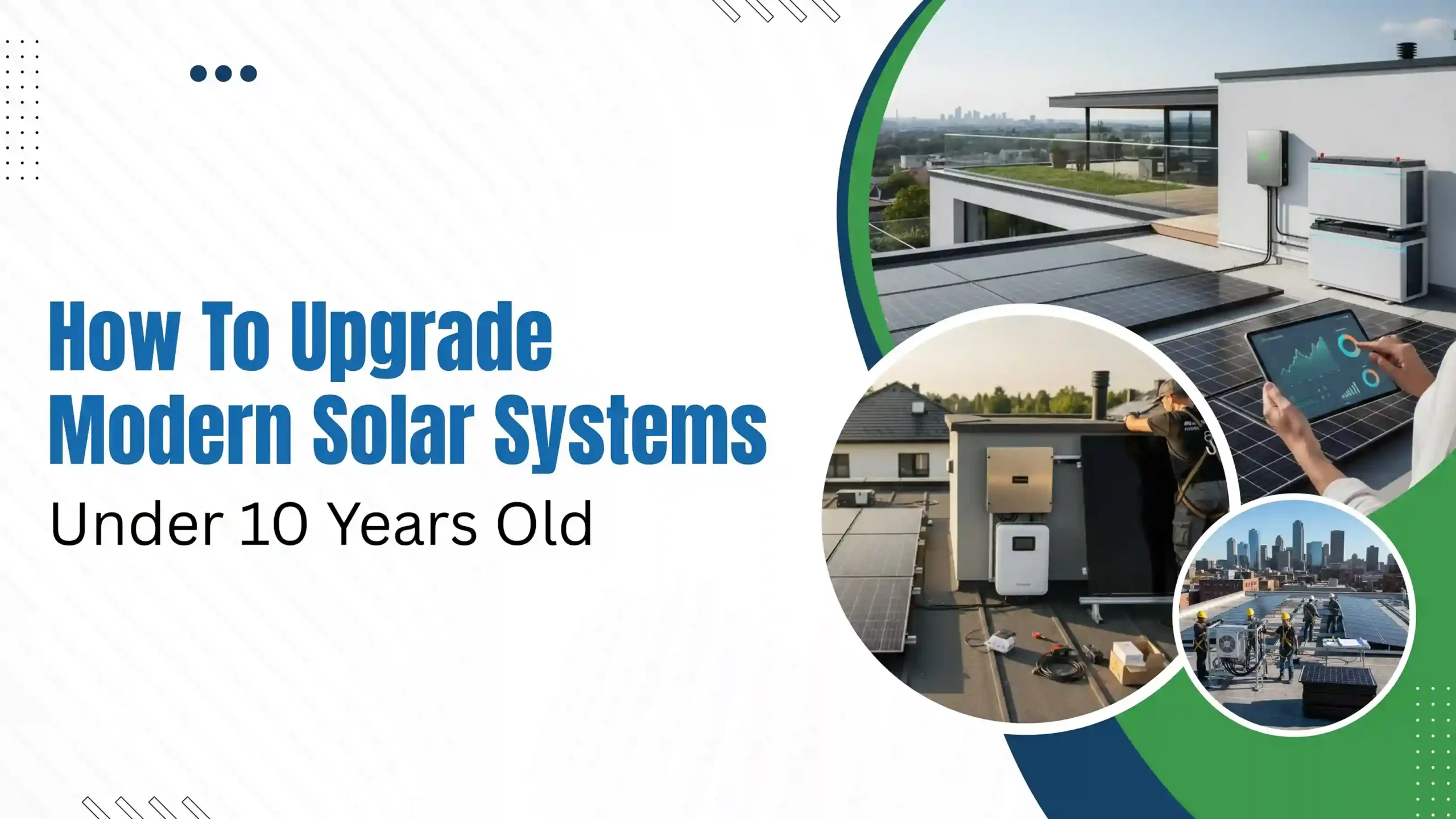
Grid-connected solar PV systems installed less than 10 years ago may remain structurally sound but may no longer satisfy current energy demand, network conditions, or technological requirements. A structured solar panel upgrade can increase energy production, enable battery integration, improve monitoring capability, and restore system performance without full replacement.
Systems under 10 years old require detailed assessment of electrical compatibility, inverter constraints, grid export limits, and AS/NZS compliance before any upgrade is implemented.
When a Solar Panel Upgrade Is Necessary
In systems under 10 years old, module degradation typically ranges from 0.5 to 0.8 percent per year. At 8–10 years, the overall degradation can reach approximately 4–8%, which alone does not justify replacement. Nevertheless, upgrades can be justified according to the following conditions:
- Further loading of the site (EV charging, electrification of heating, business growth)
- Inverter warranty expiry (typically 5–10 years)
- Limited monitoring capability or obsolete communications hardware.
- Post-installation export restrictions imposed by the DNSP.
- Requirement to incorporate battery storage.
- Arrays not performing to expectations: e.g. mismatch or design constraint.
This assessment must involve comparison of actual yield (kWh/kWp/year) with expected irradiance-adjusted production. If performance losses exceed anticipated degradation, further technical investigation should be conducted before expansion.
Technical Limitations of Older Inverters
Inverters installed 5–10 years ago often present technical limitations during a solar upgrade:
Small DC Oversizing Capacity
Earlier inverter models were typically designed for DC-to-AC ratios of 1.1–1.2. The common ratios of modern systems are 1.3 to 1.5. Without replacement of inverters, clipping loss can rise to unacceptable levels with the addition of more modules.
MPPT Constraints
Older inverters usually have:
- 1–2 MPPTs
- Narrow voltage windows
- Reduced current input capacity (e.g. 11–13 A per string)
Modern high-current modules (13–15 A Imp) may exceed MPPT input current ratings, resulting in input current clipping.
No Battery Compatibility
There are numerous older generation string inverters that do not have DC battery ports or a hybrid option. AC coupling can also be used but this will create losses in efficiency and extra protection needs.
Communications Limitations
Older monitoring systems may rely on 3G modems or proprietary communication hardware no longer supported by network providers.
DC System Constraints in Expansion Projects
DC design validation is required before expanding an existing system.
String Design and Voltage Matching
When adding modules:
- The minimum site temperature open circuit voltage (Voc) should not exceed inverter maximum DC voltage.
- The operating voltage (Vmp) has to be within MPPT tracking range.
- The same string should not be occupied with mixed types of modules unless they have close electrical characteristics.
String imbalance or 2–10% reduction of the output can be caused by voltage mismatch.
Current Compatibility
Parallel string current can be greater than inverter input limits in cases where new modules have high Imp ratings than actual strings. String fusing and cable ampacity also should be re-examined.
Degradation Mismatch
Pairs of new modules with old worn-out modules may cause mismatch losses. A 6% difference in power between modules can drop string performance disproportionately after 8 years, by not being separately isolated by other MPPTs or optimisers.
AC-Side Constraints and Switchboard Upgrades
A solar power upgrade must comply with AS/NZS 3000 and AS/NZS 4777.
Main Switchboard Capacity
Key checks include:
- Busbar rating
- Main switch current rating
- Available breaker space
- Thermal loading
If inverter capacity increases, switchboard upgrades or sub-board installation may be required.
Protection Coordination
Protection devices should be checked on the following:
- Overcurrent coordination
- RCD compatibility
- Backfeed protection
- Anti-islanding compliance
Lack of proper coordination may bring about nuisance tripping or failure of fault clearance.
Grid Export Limits and Network Permission
Many Australian DNSPs have reduced export limits to 5 kW per phase or dynamic export control requirements.
Installers should:
- Present redrafted system design to be approved.
- Confirm alterations of export limits.
- Determine the necessity of export restricting equipment.
- Check the compliance of the inverter with the existing grid support requirements.
Modern inverters must comply with the modified AS/NZS 4777.2 standards of voltage ride through and reactive power regulation. Older inverters can fail to comply with new firmware.
Hybrid Inverter Retrofits and Battery Integration
One of the major causes of system upgrades is battery integration.
AC-Coupled Batteries
Advantages:
- Minimum modification in the PV arrays.
- Independent operation
Limitations:
- Double conversion losses
- Individual inverter and protection units.
Inverter Replacement- Hybrid
A hybrid inverter can be used to replace a legacy string inverter to make it:
- Direct DC connection of battery.
- Improved MPPT capacity
- Higher DC oversizing ratios
- Integrated monitoring
Nevertheless, compatibility should be ensured in:
- Battery voltage range
- Charge and discharge power limits.
- Grid-forming capability (where required)
Hybrid retrofits may require switchboard rewiring and renewed protection schemes.
Module-Level Power Electronics (MLPE) Options
Without a complete replacement of power inverters, MLPE technologies have the capacity to improve the performance of the system.
Power Optimisers
- Installed at module level
- Reduce mismatch losses
- Enhance work with partial shading.
- Enabling module-level monitoring.
Nonetheless, the optimisers should be inverter architecture compatible.
Microinverters
Microinverters convert module DC to AC. In retrofit scenarios:
- Appropriate in case of adding small supplementary arrays.
- Suitable to complicated roof directions.
- Lessen the voltage limitations of strings.
They need AC trunk cabling and network compliance checks.
Panel Repowering vs Inverter Replacement
There are two major upgrade paths, which are:
Panel Repowering
Includes the replacement of older modules with higher wattage panels while retaining the existing inverter.
Constraints:
- String voltage should be kept in order.
- Inverter DC input limits must not be exceeded.
- Physical mounting compatibility must be verified.
Repowering enhances the energy density and could be constrained by the inverter capacity.
Inverter Replacement
Replacing the inverter allows:
- Higher DC oversizing
- Additional MPPT channels
- Ability to incorporate batteries.
- Modern grid compliance
In many systems under 10 years old, inverter replacement delivers greater performance improvement than panel-only upgrades.
System Monitoring Upgrades
Modern monitoring provides:
- Tracking of production in real-time.
- Fault diagnostics
- Logging of export limitation compliance.
- Revenue-grade metering for commercial systems.
Upgrading communications modules or replacing monitoring gateways improves asset management and enables accurate performance benchmarking against irradiance data.
Expansion vs Full System Replacement
Technical feasibility of expansion occurs when:
- Sufficient unused roof space is available.
- DC oversizing remains within inverter design limits.
- Added AC load is supported by the capacity of the switchboard.
- Network approval is granted
Full system replacement should be considered when:
- The inverter is obsolete or non-compliant.
- There is a deterioration in mounting systems.
- Export restrictions inhibit significant growth.
- The cost of incremental upgrades approaches 60–70% of full system replacement.
Lifecycle cost modelling is to compare:
- Levelised cost of energy (LCOE)
- The inverter warranty value that is remaining.
- Exposure to future maintenance.
Financial and Performance Factors
A properly engineered solar upgrade can deliver:
- 15–40% more energy production per year (according to the scale of expansion).
- Better self-consumption rates with battery incorporation.
- Less clipping loss by enhanced DC oversizing.
- Reduced time out by improved monitoring.
Performance modelling must be able to consider:
- DC-to-AC ratio optimisation
- Forecasting the output that has been adjusted by degradation.
- Export limitation impacts
- Tariff structures of time of use.
The return on investment is enhanced when the upgrades are in line with a higher level of consumption at the site, as compared to a situation where feed-in tariffs are entirely relied upon.
Risks of Improper Upgrades
Poorly done upgrades may pose serious technical risks:
- Voltage mismatch leading to MPPT instability.
- Inverter overloading of current.
- DC isolator overrating or under-rating.
- Failure in co-ordination of protection.
- Failure to adhere to new standards of AS/NZS.
- Disconnection on network because of export breaches.
Mismatch losses are sufficient to decrease the expected gains by 5–15% in case the module characteristics are not matched.
Conclusion
Upgrading a solar PV system under 10 years old is a strategic technical undertaking that requires a deep understanding of DC string physics, power electronics, and evolving regulatory standards. By focusing on MPPT compatibility, inverter oversizing, and MLPE integration, asset owners can transform an aging power plant into a high-yielding, grid-compliant, and storage-ready energy resource.
You Might Also Like