Across the UK, homeowners are increasingly prioritising customised storage that aligns with architectural character and contemporary living demands. Space efficiency and design cohesion are key considerations in Victorian terraced houses as well as newly constructed flats. In this regard, built in furniture for living room applications offers a long-term solution, integrating storage directly into the structure of the home.
Compared to freestanding units, living room fitted furniture is designed around specific dimensions, ceiling heights, chimney breasts and alcoves. It enables architectural harmony without compromise. Through carefully considered fitted lounge furniture ideas, spaces can be arranged in an uncluttered manner while maintaining proportion and harmony. Design principles are further applied to dining and study spaces, with custom-made cabinetry making them more practical while maintaining overall design continuity.
Living Room Furniture Solutions: Specificity and Integrity
The living room is the central space of the home and requires a careful balance between relaxation and storage. Alcoves are underutilised in many UK properties, particularly in traditional homes with fireplaces.
Media Walls and Alcove Cabinetry
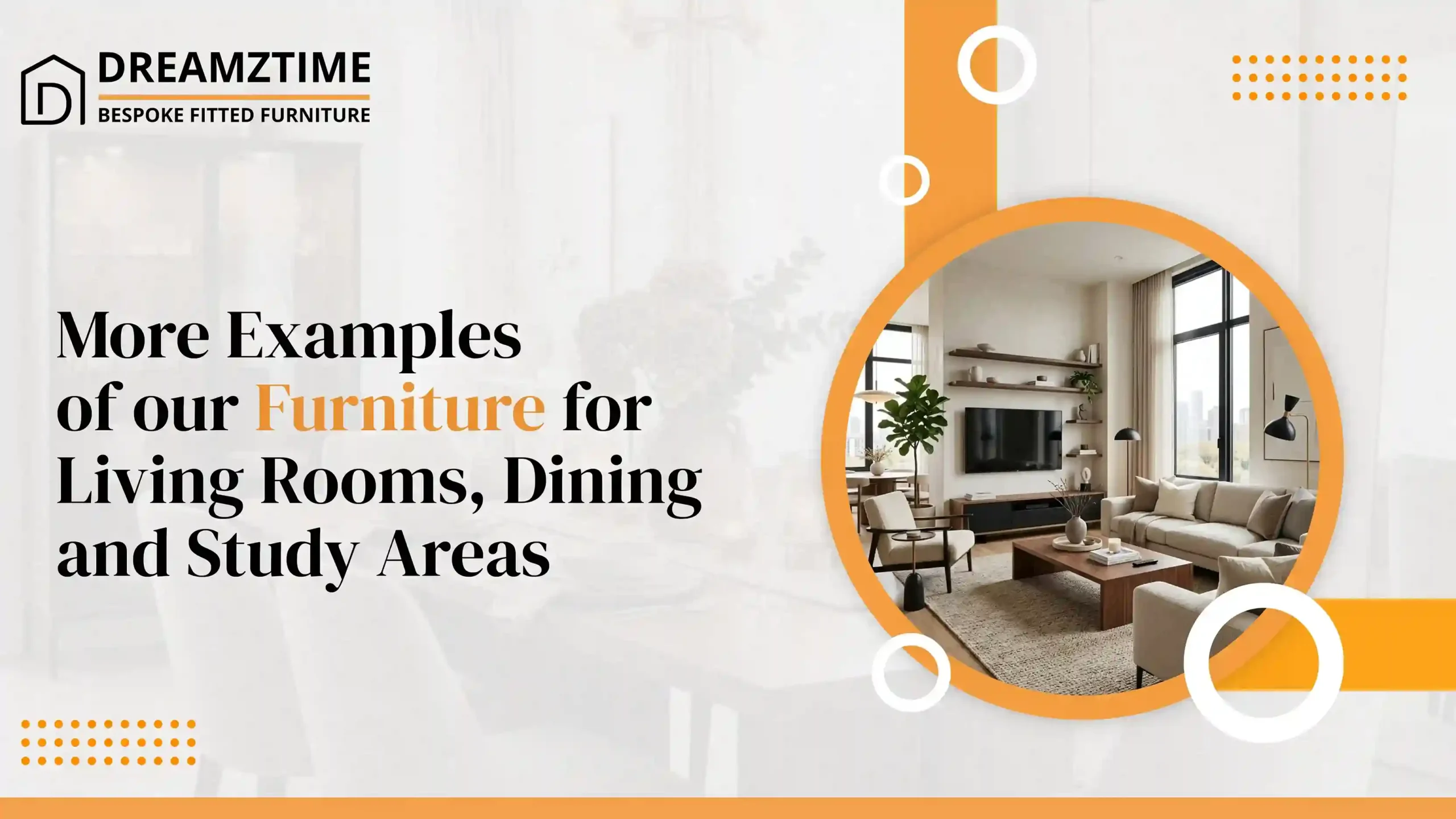
A comprehensive example of living room fitted furniture is the design of customised media walls. Instead of viewing the television as a detached object, a tailor made product incorporates technology into the design of the room. These installations may accommodate built-in screen frames, hidden cable management, and integrated soundbar recesses. Alcove cabinetry is always a favourite when it comes to fitted lounge furniture. Floating shelves placed above base cupboards ensure that the proportions of the room remain intact and that the homeowners have ample storage space in which they may store media hardware and books.
Floor-to-Ceiling Shelving and Hidden Storage
Vertical planes can be maximised by using floor to ceiling shelves as an effective use of built in furniture for living room design. This approach eliminates dust-collecting surfaces often found on top of freestanding wardrobes or bookcases. Moreover, the use of push-to-open handleless doors provides the opportunity to reserve some hidden storage units that do not stand out against the wall and create an illusion of minimalism, as well as storing large household objects.
Dining Area Furniture: Enhancing Social Spaces
Modern UK living rooms are frequently also used as a place of work or a secondary social space. Furniture in this case has to be custom-made in a way that it does not disrupt the formal or social nature of the room.
Built-in Display Cabinets and Glass-Fronted Units
In the case of dining areas, glass faced cabinets will offer a chance to display glassware and ceramics without being dusted. These units can become focal points through the use of toughened glass and integrated LED spotlights. Such customisation ensures the cabinetry aligns with coving or dado rails, creating a fully integrated and flush appearance.
Sideboards and Storage Benches
Storage benches are a two-in-one solution in smaller dining rooms in semi-detached houses. These are designed with seating at the dining table, with lift-up lids or drawers that can be pulled out to store linens and other seasonal goods. A fitted sideboard has the ability to extend along the full length of a wall, unlike a freestanding sideboard, which can be designed to form a continuous surface, giving the impression of extending the width of the room.
Study and Home Office Areas: Ergonomics and Efficiency
The home office has become a necessity with the emergence of hybrid working in the UK. Study furniture of professional grade aims at technical integration and ergonomic comfort.
Bespoke Fitted Desks and Filing
A bespoke fitted desk can be contoured to fit into corners or under stairs, areas where standard desks would be impractical. Integrated filing storage—designed to accommodate A4 or foolscap folders—ensures that the workspace remains clutter-free. By choosing living room fitted furniture styles that carry over into the study, homeowners can maintain a unified design language throughout the property.
Cable Management and Connectivity
Study furniture should be designed to prevent the cluttering of power leads and data cables. Bespoke installations incorporate cable grommets, concealed cable runs and integrated power sockets within cabinetry. This ensures that the aesthetic integrity of the room is not compromised by modern technology requirements.
Materials, Finishes, and Design Considerations
Material choice in built in furniture for living room and study areas is vital in determining long-term durability.
- Substrates: High-density MDF is a common substrate for painted finishes due to its stability and smooth surface. Hardwood veneers (oak or walnut) may give those interested in a natural feel the appearance of solid wood with improved resistance to warping.
- Finishes: The current UK design trends are inclined to the use of matte finishes with their sophisticated and non-reflective properties. Nevertheless, glossy lacquers are still in use in smaller flats, so as to create reflection of light in the room.
- Hardware: Hinges and handles are to be chosen. High-end bespoke furniture has soft-close mechanisms, which guarantee longevity and high-end feel.
Practical Benefits of Bespoke Fitted Furniture
There are a number of benefits to the practical side of investing in built in furniture in living rooms and dining rooms:
- Utilisation of Awkward Spaces: Fitted furniture uses every millimetre of space that is there, whether it is a sloping ceiling in a loft conversion or a small depression in a hallway.
- Property Value: Custom-made installations are often regarded as permanent additions to a property, which may improve the market value and attractiveness to prospective buyers.
- Interior Cohesion: Coordinated materials and colour palettes allow fitted furniture to align with architectural detailing, creating a seamless and cohesive interior scheme.
- Durability: Professional fitted furniture is made to endure the demands of everyday use over decades unlike alternatives in the form of flat pack furniture.
Planning and Installation: The Professional Process
The process of changing the initial ideas of fitted lounge furniture into a completed installation has to be precise. It starts with a technical survey, during which laser measuring instruments are utilised in order to compensate for the normal irregularities of the walls and floors in the United Kingdom.
Through the design consultation, CAD (Computer-Aided Design) software enables the homeowner to comprehend the final product in his or her own unique spatial parameters. The installation is then carried out by qualified joiners, ensuring all units are scribed to walls and floors for a precise fit in accordance with UK building standards for electrical safety and structural integrity.
Conclusion
Custom tailored joinery gives a systematic answer to the space problem that most homes have in the UK. Built in furniture for living room applications provides architectural coherence and practical organisation, whether in the form of media walls, alcove cabinets or integrated study spaces.
The investment in professionally designed living room fitted furniture enables the home owners to get accuracy, longevity and value. Well thought-out fitted lounge furniture ideas go beyond aesthetics, addressing storage, technical performance and day-to-day functionality. When intelligently used throughout living rooms, dining and study room spaces, custom made fitted furniture creates harmonious interior landscape that matches the lifestyle of the British nowadays.
You Might Also Like