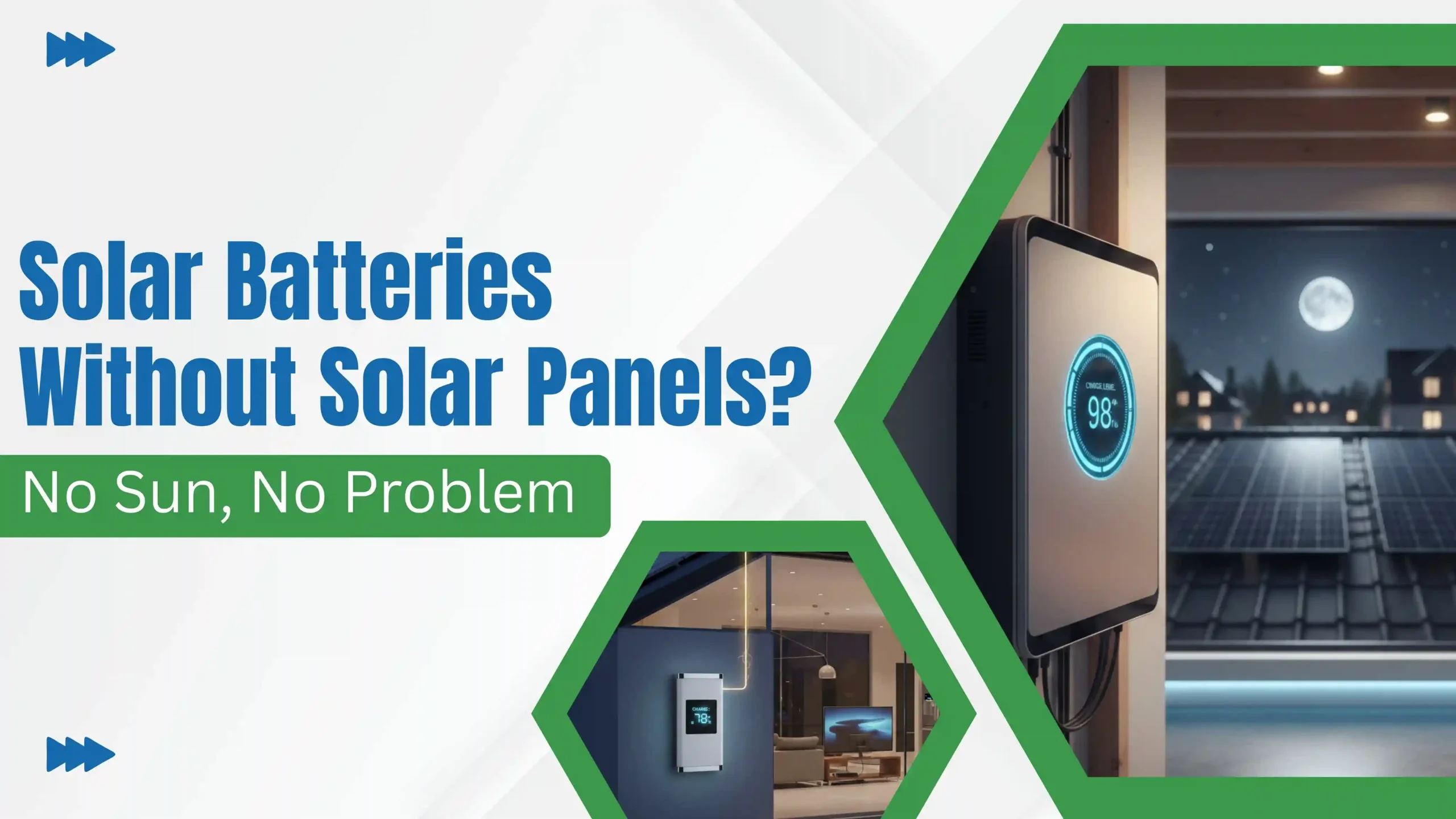
The rapid development of Battery Energy Storage Systems (BESS) has decoupled onsite generation from the benefits of energy storage. Although the conventional residential model couples photovoltaic (PV) arrays with storage, it is technically possible—and increasingly common—to deploy solar batteries without solar panels. The benefit of this configuration is that it uses the electrical grid as the primary energy source, allowing the battery to function as a load-shifting, arbitrage, and backup reserve asset.
Technical Architecture: Is it possible to have Solar Batteries working on their own?
A battery storage system does not need a direct DC input of a PV string to operate. The basic requirement of a BESS is a bidirectional connection to an energy source capable of supplying the required voltage and current for charging.
AC-Coupled/ DC-Coupled Architecture
In conventional solar without battery systems, energy from the PV array is converted through a string inverter and supplied directly to household loads or exported to the grid. In retrofit storage additions where the existing PV inverter is retained, the architecture is typically AC-coupled.
- AC-Coupled Systems: This is the system where the battery is attached to the household AC bus through its own dedicated battery inverter. It takes as input power in the grid, transforms it into DC to be stored and back to AC to be discharged.
- DC-Coupled Systems: These are normally built in a hybrid inverter in combination with a PV array. Although a hybrid inverter can be used to charge a battery using the grid, systems with this type of inverter are not commonly used without at least some basic charging batteries solar capability, since their hardware is tuned to charge using DC concurrently.
Grid Charging Capability
Stand-alone BESS systems use intelligent control logic to control charging of the grid. The unit can be programmed to check the State of Charge (SoC) and external cues, such as time-of-use (ToU) pricing, to draw power into the grid when there is low demand (or low cost).
Technical Scenarios: Battery-Only Systems and Retrofitting
The industry has widely deployed solar panels without battery storage over the past decade but the situation is now changing to standalone battery storage due to certain technical and economic factors.
Time-of-Use (ToU) Tariff Optimisation
A battery-only system is an arbitrage mechanism in jurisdictions with high dynamism in energy pricing. The system is configured to charge during off-peak periods (e.g., 12:00 AM to 6:00 AM) when wholesale or retail rates are at their lowest. This energy is then released on peak windows (e.g., 5:00 PM to 9:00 PM) effectively limiting the amount of money spent by the consumer to the off-peak rate.
Scalability and Retrofitting
Most consumers will install solar without a battery at the outset because they cannot afford a capital expenditure. It is possible to do a phased retrofitting of a battery later. Nonetheless, when the existing solar inverter is not battery-ready (i.e., not a hybrid inverter), the only option without replacing the primary inverter is an AC-coupled battery system. In other instances, there may be limitations on what is available on site like excessive shading or heritage buildings that will not allow any installation of PV and the only way to achieve energy resilience would be by installing a standalone battery.
Conversion and Efficiency of Energy: Solar vs. Grid Charging
The physics of energy storage dictates that each energy conversion step introduces losses. In the case of system design, it is important to analyze the round-trip efficiency (RTE).
Conversion Losses
In a DC-coupled hybrid inverter, PV energy typically undergoes a DC-to-DC conversion stage through MPPT and charge control circuitry before entering the battery, with conversion efficiencies generally between 94–97% depending on system design.
Conversely, grid charging includes a conversion of AC to DC (Rectification) after which DC to AC conversion (Inversion) takes place during discharge. Every step entails losses of heat. A high-quality AC-coupled BESS typically achieves round-trip efficiency between 85% and 89%. Engineers would need to include such losses in the ROI model, such that the arbitrage is profitable, the percentage of losses in the conversion process should be lower than the delta between peak and off-peak rates.
Inverter Role in Bidirectional Flow
The inverter is the brain that controls the bidirectional flow. In the standalone installation, the inverter needs to be able to:
- Rectification: Converting grid AC into stable DC suitable for lithium-ion cell charging.
- Grid Following: Following grid frequency (50Hz or 60Hz) to discharge without problems.
- Grid Forming (Optional): During grid outages, a local voltage reference is provided (Island Mode).
Participation in Virtual Power Plants (VPPs) and Arbitrage
A single-battery based system is an asset that is grid-interactive. An aggregator is able to manage the BESS to offer Frequency Control Ancillary Services (FCAS) or Demand Response through a Virtual Power Plant (VPP).
Arbitrage Opportunities
In comparison to a solar panel with no battery storage system, which is dependent upon a Feed-in Tariff (FiT) to achieve ROI, a stand-alone battery will create value by price spread. Released during peak demand, the system will decrease the load on the grid and will also lower the electricity expenditure to the user. VPP payments in certain markets are event payments, which greatly exceed the price of the grid electricity to charge the battery.
Backup Power Configuration
Stand-alone batteries may be programmed to:
- Backup Circuits: Refrigeration, lights, internet.
- Whole-Home Backup: Needs more peak power requirements and may need to be three-phase.
System Design Considerations and Compliance
Implementing a BESS without charging batteries solar requires rigorous electrical engineering to ensure safety, compliance, and long-term durability.
Switchboard and Metering
An independent battery entails the installation of a smart meter or Current Transformer (CT) clamps on the main switchboard. This enables the system to track real-time consumption of the household and can only release what is required by the battery, avoiding the opportunity to accidentally export to a grid unless programmed to do so during a VPP event.
Compliance (AS/NZS 4777.2 and AS/NZS 5139)
Installations in Australia and New Zealand must comply with AS/NZS 5139, which is used to determine the location, fire separation, and bollard of battery enclosures. Additionally, the inverter should comply with AS/NZS 4777.2 with regard to connection to the grid, i.e. it is necessary that it should be able to react to variations in voltage and frequency to keep the grid stable.
Technical Limitations and Degradation
Engineers have to consider capacity sizing in terms of the load profile. The high power rating of a battery (in kW) may support high-draw loads such as HVAC units, and the high energy capacity of the battery (in kWh) will dictate how long such a load may be supported. Arbitrage cycling will be stressful on the battery, and a BMS to regulate depth of discharge (DoD) needs to be used to optimize the lifecycle (usually 6,000 to 10,000 cycles).
Financial and Performance Analysis
Solar Panel Battery-Only vs Without Battery Storage
Solar panel: No battery storage system:
- Reduces daytime import
- Provides feed-in revenue
- Has reduced cost per kWh saved of capital.
A battery-only system:
- Enables peak shifting
- Provides backup
- Allows VPP participation
Nevertheless, the stored energy is bought energy, unless the PV generation takes place. Thus, the structural limitation of economic return exists.
ROI Modelling at Various Tariffs
The ROI will be based on:
- Spread between off-peak and peak tariff.
- Feed-in tariff value
- Network demand charges
- VPP revenue streams
In markets where the feed-in tariff is reducing, the addition of storage in a solar project without battery could enhance the self-consumption ratios.
In battery only scenarios, the ROI modelling would require:
- Efficiency losses
- Degradation curve
- Replacement horizon (10–15 years on average)
Long-term expansion plan
To new installations, system design must permit:
- Future PV integration
- Additional battery modules
- Dynamic export compliance
- EV charger integration
Scalability reduces long-term capital inefficiency.
Conclusion
Energy storage is often assumed to require onsite generation; however, this is not technically necessary. Although the use of solar in charging batteries is the most effective way of realizing complete energy autonomy, standalone BESS units come with an advanced solution to demand regulation and grid stabilization.
With the implementation of solar batteries without solar panels, commercial and residential clients can overcome the threat of high peak energy prices and share the emerging grid services economy. Standalone storage is a strong technical option whether it serves as preparation for future PV integration or as a strategic response to existing solar without battery limitations. For properties currently operating with a solar panel without battery storage system, the logical progression toward greater energy resilience lies in leveraging the bidirectional capabilities of modern inverter technology.
You Might Also Like