Business owners! Were you able to file GST annual returns? No? Ahh, you are among those last-minute payers, professional bodies and businesses who have requested extensions up to January 31, 2026, due to late procedural clarifications. As we know, earlier, the statutory due date for the GST filings was December 31, 2025. However, a large number of businesses weren’t able to do so. For every Indian business, filing GST annual returns is the most important compliance or a kind of Red-letter day. Filing the GST means the to include everything, all monthly and quarterly filings for the financial year. Now, a lot of things have changed, and people are still unaware of these changes. Yes, for the 2024-25 fiscal year, the process has not only become more intense but also has changed due to new structural changes in reporting logic and increased data interdependency.
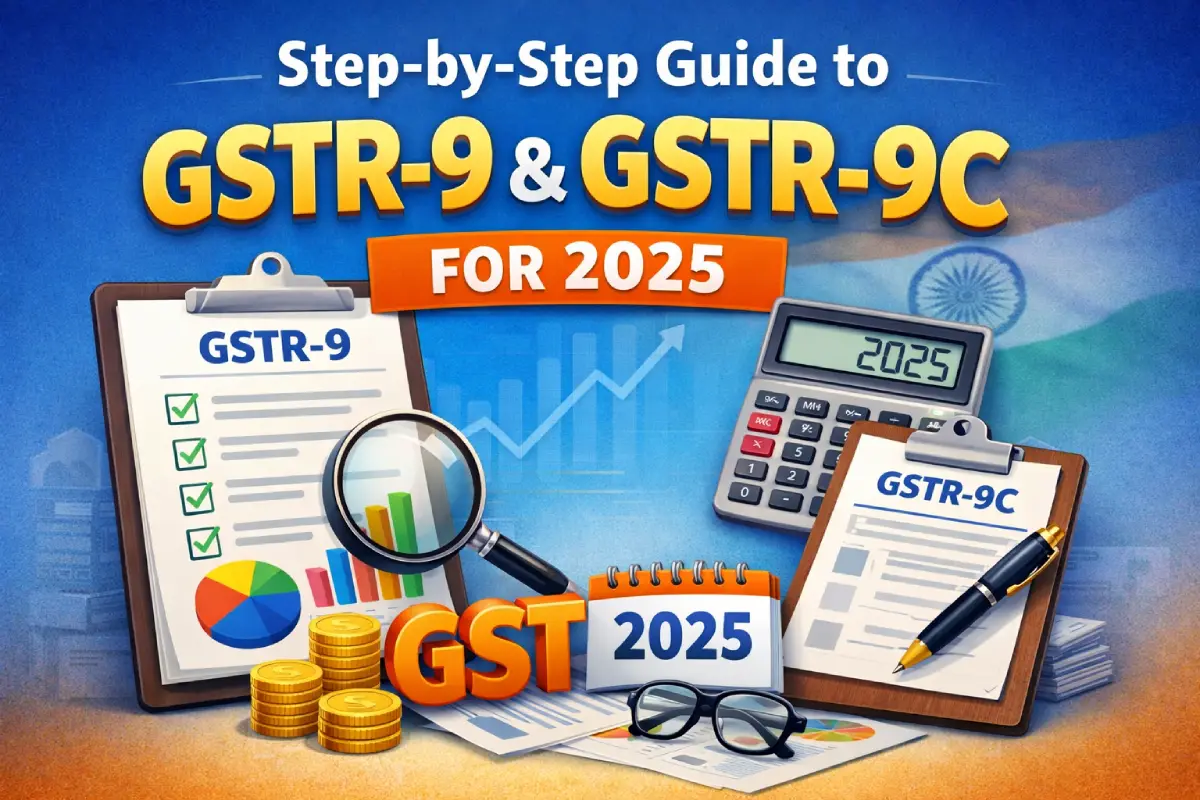
There are several structural changes in the reporting tables, especially regarding Input Tax Credit or ITC tracking. Hence, it requires a high level of precision to avoid double taxation. Worries are inevitable, but ease up your shoulders a bit because this step-by-step guide to GSTR 9/9C can help you understand the process easily!
Section- Outward Supplies: The Sales Ledger (Part II)
Let’s start with the section on outward supplies. This section requires a complete breakdown of all sales your business made during the year. Therefore, you need to put every minor to major or complete sales data here. If your turnover is above ₹5 crore, you should report your 6-digit HSN summary in Table 17. On the other hand, if your annual turnover remains under this limit, you are exempt from this requirement. Transparent and clarified, isn’t it? Also, the filing requirements are determined by your annual turnover, which decides whether you must file just the annual return or an additional reconciliation statement.
Return Type |
Turnover Threshold |
Mandate Status |
| GSTR 9 | Above ₹2 Crore | Mandatory for regular taxpayers |
| GSTR 9 | Up to ₹2 Crore | Optional/Exempted for small taxpayers |
| GSTR 9C | Above ₹5 Crore | Mandatory (Self-certified reconciliation) |
Table 4 (Taxable Supplies)
Now, let’s understand Table 4 and what you should put here. In this table, you should report B2B, B2C, and Deemed Exports. This means all kinds of taxable supplies. While Credit/Debit Notes for these supplies can be adjoined with Table 4, but we suggest you show them in Tables 4I to 4L. This way, you are making a cleaner audit trail.
Table 5 (Exempt Supplies)
This table is for Nil-rated and Non-GST supplies. For ease of filing, ‘Exempted’ and ‘Nil-rated’ supplies can be joined together in Table 5D. However, remember, Non-GST supplies should be shown separately in Table 5F.
ITC Or Input Tax Credit: The Reconciliation Core (Part III)
It’s time to move further! This is the most important and scrutinized part of the return. Here, your claimed ITC is compared against the government’s auto-populated records.
New Tables 6A1 and 6A2
These were introduced specifically for the 2024-25 cycle to identify ITC of the preceding year that was claimed in the current year. This prevents the inflation of current-year credits.
Table 6B (Inward Supplies)
You are still required to break down ITC into ‘Inputs,’ ‘Capital Goods’, and ‘Input Services’. However, most taxpayers now have the option to club ‘Inputs’ and ‘Input Services’ together, provided ‘Capital Goods’ are reported separately.
Tables 7A1 and 7A2
These new sub-tables require specific disclosure of ITC reversals under Rule 37A (non-payment by suppliers) and other statutory reversals, making blanket reversals outdated.
Know This Step-by-Step Filing Guide!
Step 1. Reconcile The Data
This means you must ensure that your audited financial statements, GSTR-1 (outward supplies), and GSTR-3B (tax paid) are in perfect sync.
Step 2. Now, Verify the Input Tax Credit or ITC
For FY 2024-25, Table 8C now specifically includes ITC for the current year even if it appears in the GSTR-2B of the subsequent year (April–October 2025).
Step 3. Download System-Generated Summaries
Open the GST portal and download the auto-populated GSTR-9 (from GSTR-1/3B) and the GSTR-2A/2B comparison reports to identify discrepancies.
Step 4. Now, Fill All Mandatory Tables
Update Table 4 (Outward Supplies), Table 6 (ITC Availed), and Table 17/18 (HSN Summary), ensuring that any taxes paid via DRC-03 are correctly reflected.
Step 5. Submit GSTR-9 and Initiate 9C
Once the GSTR-9 is filed, the portal enables GSTR-9C for those above the ₹5 crore threshold. It is to reconcile the difference between the GSTR-9 turnover and the audited balance sheet.
What Has Changed?
A lot of things have changed. The Central Board of Indirect Taxes and Customs or CBIC, has introduced Notification No. 13/2025-CT. This notification no. mandates more precise reporting of ITC reversals and rule-wise breakdowns. Earlier, we all knew how some tables were optional. But not anymore. Reporting for HSN-wise summaries of outward supplies has now been made mandatory for businesses (with turnover more than ₹5 crore). Additionally, you can not file GSTR-9 on the portal unless you make sure every single GSTR-1 and GSTR-3B for the financial year has been successfully filed.
For end-moment filers, you must pay heed to the late fees. Each day you delay filing your GST filing, you will have to pay GSTR-9 late fee fine of ₹200 per day (₹100 CGST + ₹100 SGST), capped at a maximum of 0.50% of the turnover in the State or Union Territory. Also, if any tax liability is discovered during the annual reconciliation, you are bound to pay it via Form DRC-03 along with applicable interest. Therefore, you should never delay filing the GST. Cheering for you for a happy filing!
You Might Also Like