Task management has become the base layer of the operational implementation in the modern business world. In contrast to project management, which is frequently used interchangeably, task management is concerned with the nuts and bolts lifecycle of individual actions, between their beginning and their end. To the technology leaders, to comprehend how to manage tasks, it is important to perceive it as an important part of a wider work management strategy. Whereas project management is used to regulate a temporary undertaking that has a set end, work management offers a permanent approach to the balancing of the structured undertaking and repetitive operation undertakings.
Proper management of tasks necessarily implies that the top-level strategic goals will be broken into active components. The implementation of a highly functional employee task managing system has ceased to be a choice, it is a pre-condition in the times of distributed teams and sophisticated digital ecosystems, which allows keeping visibility, accountability, and professional-level throughput.Core Components of Task Management
Task management should be far more serious than to-do lists: to realize enterprise-level efficiency, it should be backed by stringent structural elements.
- Prioritization Models: The application of the models such as the Weighted Shortest Job First (WSJF) or Eisenhower Matrices to match daily output with ROI.
- Resource Allocation: This is a process of mapping the tasks to particular skill sets and availability to avoid bottlenecking.
- Dependency Mapping: This is needed to identify paths in a complex work management flow to which the completion of a given task is a prerequisite to another.
- SLA and Deadline Management: To create definite constraints and Service Level Agreements (SLAs) in order to create predictable delivery cycles.
- Monitoring and Reporting: Data ingestion in real-time to monitor the progress in accordance with benchmarks.
Architecture of an Employee Task Management System
The multi-layered architecture forms the backbone of a sophisticated employee task management system.
Workflow Engines
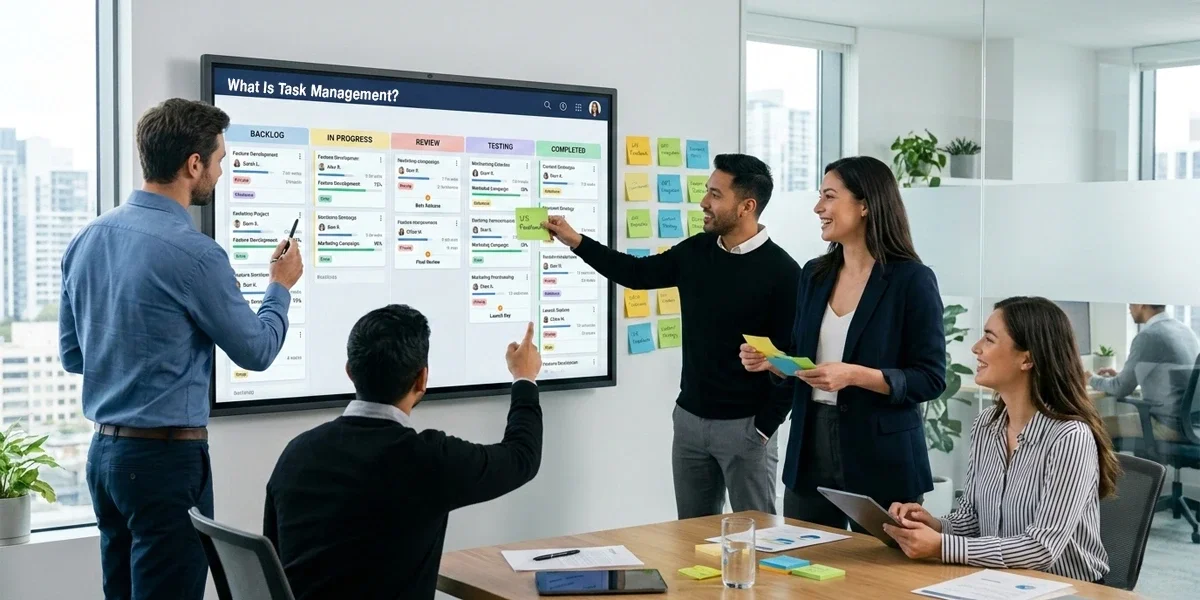
A logic engine is at the heart of it that determines the flow of tasks through different states (e.g., Backlog, In-Progress, QA, Done). This engine fosters breaching logic and automatic transitions on the premise of definite triggers.
Role Based Access Control (RBAC)
Security is paramount. RBAC should be enabled by enterprise systems so that data related to sensitive tasks is available to authorized employees only, and it should be compatible with Identity and Access Management (IAM) standards, such as SAML or OAuth.
Integration Ecosystem
The system of employee task management is not in a vacuum and it is a high performance model. It needs in-depth two-way integration with:
- ERP /CRM: To connect the tasks with customer contracts or financial milestones.
- DevOps Tools: To align the technical debt with the product roadmaps.
- HRMS: To match the tasks assignments to the employee availability and performance history.
How to Manage 10 Most Important Tasks as an Enterprise
- Jira (Atlassian): The agile software development standard. It is highly customizable when it comes to issue tracking and is built-in with Bitbucket and Confluence.
- Asana: A flexible work management service and software that delivers effective cross-functional coordination via the data model called the Work Graph.
- Monday.com: It is very visual and modular and enables quick building of custom workflows that are automated without much code.
- Wrike: With high-performance features, including strong Gantt charts and advanced views on the workload of resources.
- ClickUp: A highly integrated service that strives to substitute a set of applications by including documents, objectives, and dialog into the system of managing tasks of employees.
- Smartsheet: is a spreadsheet-like interface offering extensive computational functionality to track heavy-data task management.
- Trello: It is based on the Kanban method, which is suitable in visualizing the flow of tasks and simple streams of operation.
- Microsoft Planner: A fully integrated part of Microsoft 365, this will be the most logical option among those enterprises that have gone to lengths to invest in Azure and Teams.
- Notion: Serves as a modular knowledge workspace; enterprise-suitable for knowledge-centric teams. Its flexible database enables document-based task management integrated with work management dashboards.
- Basecamp: Focused on transparency and simplified communication; enterprise-suitable for client-facing projects requiring centralized task visibility and limited integration with other enterprise systems within an employee task management system.
Role of Task Management in Enterprise Work Management
- Consistency with Strategic Objectives
Task management is an operationalization of strategic priorities which translates high level goals into work items and measurable outcomes.
- Cross-Functional Coordination
A company-wide activity map allows functional areas to work synchronously, and it does not have silos or duplicate efforts.
- Predictive Workload Balancing
Predictive algorithms assess future workload imbalances and dynamically rebalance task assignments to mitigate bottlenecks.
Industry research indicates that enterprises adopting advanced work management platforms with AI augmentation report measurable productivity gains and reduction in cycle times. The global task and work management software market continues to grow at double-digit CAGR, driven by demand for operational visibility and automation.
Implementation Strategy
The implementation of a new work management system will need an organized technical advisory strategy:
- Process Audit: Evaluate current workflows within the broader work management framework to identify inefficiencies and manual interventions.
- Selection of the tools: Platforms should be assessed for security compliance, integration capabilities, and compatibility with the enterprise employee task management system.
- Governance Model: Have a set of rules governing the entry of tasks, status updates, names etc.
- Change Management: Staged roll out plans to guarantee the reception of the change and data integrity.
Key Metrics and Performance Indicators
To measure the effectiveness of an employee task management system, organizations need to follow:
- Task Completion Rate: This is the proportion of tasks done in a period or a sprint when compared to the number of tasks allocated.
- Throughput: The amount of work units that are done within a time.
- SLA Adherence: The proportion of work that is done in the set time limits.
- Resource Utilization: Determining over-taxed or under-utilized human capital.
Common Challenges
- Task Overload: Tasks are not prioritized and thus they are assigned too many tasks.
- Fragmentation of tools: The fragmented systems lack integration hence gaps in visibility.
- Visibility Gaps: Due to the unavailability of centralized dashboards, decision-making will be hindered.
- Poor Delegation: Ineffective definition of responsibilities results in poor performance.
- Insufficiency of Data-driven Optimization: Handbook processes hamper continuous improvement.
Strategic Outlook
The future of enterprise work management lies in AI-powered employee task management system that can provide smart prioritization, predictive analytics, and smooth coordination across the hybrid work environments. Those organizations that consider task management as part of their digital transformation playbooks will experience quantifiable efficiency improvements and resiliency.
Finally, effective work management is based on the ability to manage tasks. Enterprise performance is impossible without the deployment of a powerful employee task management system supported by the appropriate tools, governance, and analytics.
You Might Also Like