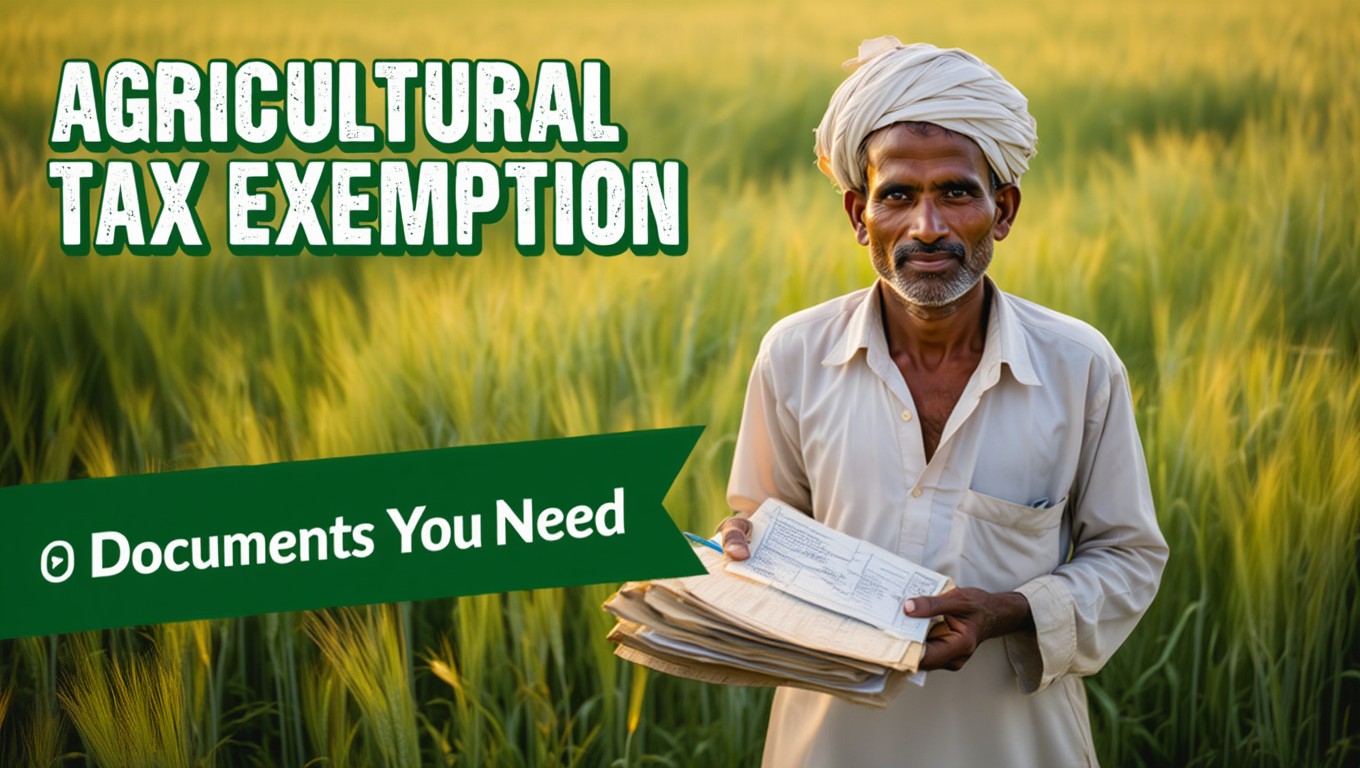
Advanced technologies in farming have made it easier for farmers to gain more from the fields. We are all aware that half of the country’s population is dependent on agriculture, and it contributes to GDP greatly. But, ‘Is the agricultural sector exempt from income tax?’ A lot of people ask this question quite often. If you are a farmer, you already know the answer that India’s tax code carves out a rare exemption for the agricultural income under Section 10(1). This means agriculture selector has an exemption from income tax, but only if you have proper documentation, such as an agriculture income certificate.
Nowadays, tax authorities have become more strict and are closely checking authentic farm income proof to prevent tax evasion, so you must provide proof that your earnings are from genuine farming. The digital scrutiny is necessary and this is why the CBDT guidelines include mandatory verification (agriculture income certificate) for farmers, landowners, and even urbanites with rural holdings.
First, Understand the Exemption!
We all know agricultural income enjoys full exemption. Nope! This is a misconception. Article 46 of the Constitution’s State List reserves taxing it for states, while the Centre focuses on non-agricultural revenue. Certain Sections, such as Section 2(1A), define what qualifies for complete tax exemption. It covers rent from farmland, profits from growing crops (think tilling, sowing, reaping), and even simple post-harvest tweaks like threshing wheat or sun-drying spices, things any cultivator does to get produce to market. However, trading seeds or selling processed goods comes under taxable income, and that’s why you need to show a proper agriculture income certificate.
Most farmers miss this important detail known as Partial Integration. This means even exempt, agricultural income becomes a taxable income if your non-agricultural earnings exceed or go beyond specific threshold. That’s why you need proper records, as it will ensure not just exemption but also accurate slab computation. Let’s see why documentation is essential for you and which documents are essential, other than the agriculture income certificate!
Why is the Documentation Essential?
Nowadays, a simple self-declaration cannot be enough as people misuse it quite often. The misuse emerged due to various high-profile cases where some politicians or businessmen used it to convert their black money into farm income. There were claims without corresponding land capacity or proper sales trails. Hence, we now follow structured checklists. If you fail this checklist, and your agricultural income shows as unexplained credits under Section 68, you are bound to pay tax plus penalties. That’s why documentation, such as a proper agriculture income certificate, is essential.
Which Documents Are Essential?
-
Land Credentials
This is your first essential document. You must show a proper 7/12 extract (Maharashtra), khasra-khatauni (UP, north India), or pahani/adangal (south), or revenue slips detailing ownership, tenancy, and soil class. Also, mutation entries, such as post-inheritance or sale deeds, come under land credentials. If you have leased land, you must have notarized agreements that specify acreage, crop shares (batai), and duration. Remember, oral tenancies won’t hold in scrutiny.
-
Cultivation Activity Proof
Even the smallest amount of purchase matters! It means you should maintain a crop register that consists of sowing dates, acreage per crop, invoices for fertilizers, etc., from the local shop. You must stack bills for seeds, fertilizers, pesticides, diesel for tractors, electricity for tubewells, and labour chits for workers over harvest. This type of cost ledger is essential for a valid agriculture income certificate. Also, take photos of standing crops, or keep drone shots if you are a modern tech-savvy farmer, or perform soil tests and data to add more credibility.
-
Sales Proof
This is the most important document for you. Yes, you must remember this essential thing from the checklist: mandi receipts from APMC yards (quantity, grade, rate, net after commission) or e-NAM portal slips are pure gold. Also, direct farm-gate sales need serialized bills; for bulk to processors, GST invoices with buyer PAN. Transport dockets (lorry receipts) and godown slips bridge farm-to-market.
-
Bank and Cash Trails Proof
A clear money trail is necessary for all kinds of filing, isn’t it? Move most of the sales through accounts. Your bank statements should show the sale proof clearly, whether it has come from your crop sale or not. Keep a cash book for balance! This book should have the daily inflows/outflows balancing to nil or petty stock to produce a proper agriculture income certificate.
Know The ITR Filing
You should file via ITR-2 or ITR-3. Schedule EI demands granular disclosure. If you are filing it via e-filing, you should attach land documents. Remember to cross-check each detail as a mismatch with Form 26AS or AIS (Annual Information Statement) would mean income tax notices. Also, as we discussed earlier, be mindful of certain lapses as there will be penalties for these kinds of faults, such as a penalty for unexplained income.
We hope this checklist makes your filing easier, happy filing!
You Might Also Like