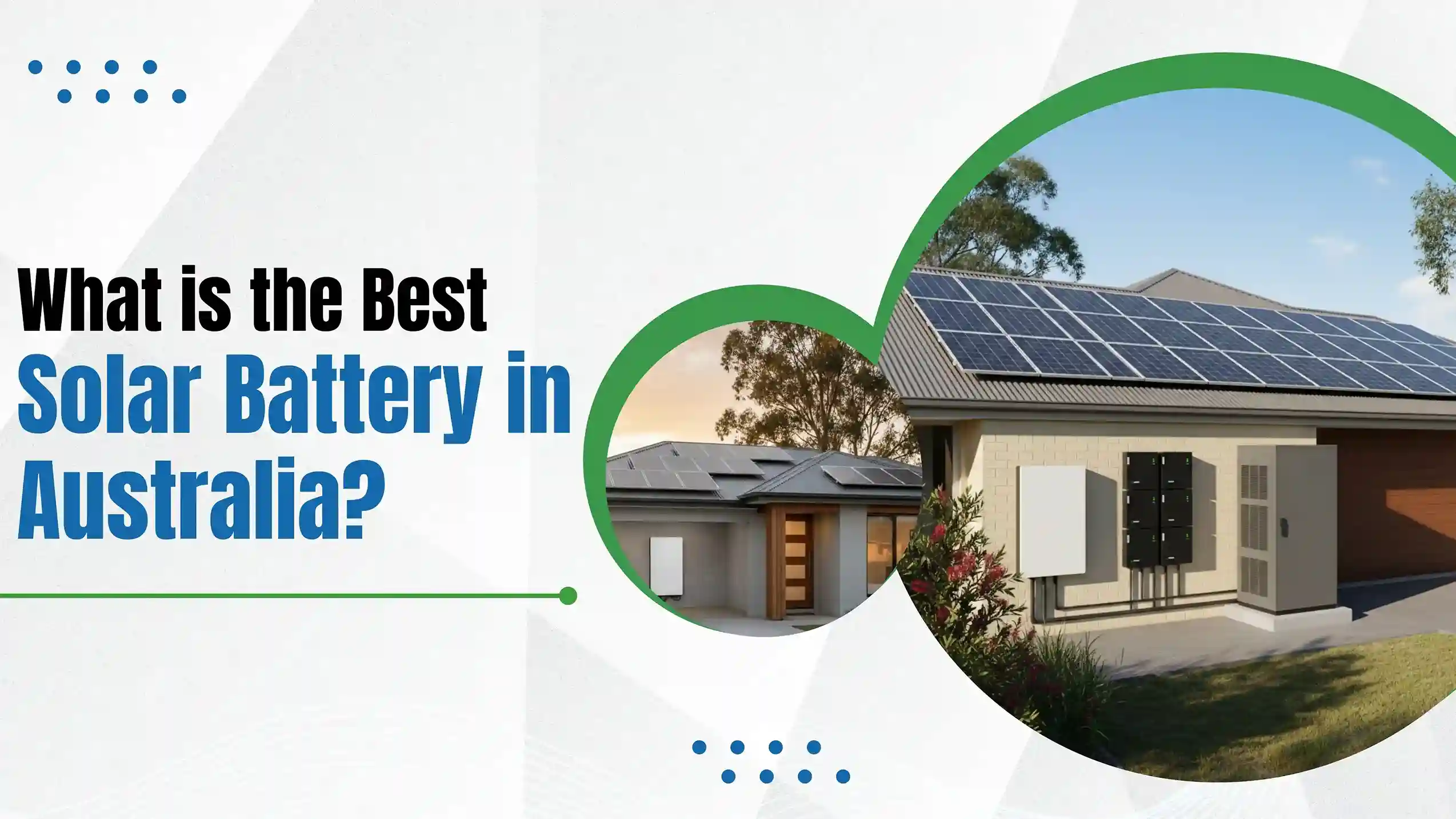
The issue of the best solar battery Australia cannot be solved by brand choice or even popularity of the market battery. An evaluation that is technically viable should take into consideration performance specifications, compliance requirements, system integration capability, and long-term economic return.
In both residential and commercial applications, to choose the best solar batteries Australia, there must be an organized evaluation of the choices to engineering standards that can be measured. The best system is based on the load profile, tariff structure, inverter architecture and compliance with the regulations.
Technical Assessment of the Most Effective Solar Powered Battery
Usable Capacity (kWh)
Nominal capacity is not the same as usable ones. Usable capacity depicts the energy that is left after taking into consideration the limits of Depth of Discharge (DoD).
For example:
- A 13.5 kWh battery at 100% DoD provides 13.5 kWh of usable capacity.
- A 13.5 kWh battery at 90% DoD delivers 12.15 kWh usable.
In the comparison of the best solar powered battery, the cost and performance modelling metric is usable kWh.
Depth of Discharge (DoD)
DoD establishes the limits of safe usage of stored energy without increasing the degradation rate.
- LiFePO 4 systems usually permit 90–100% DoD
- Commonly, DoD is limited to 80–90% by the NMC systems.
Greater DoD enhances usable capacity, but has to be compared with cycle life warranty.
Round-Trip Efficiency
Round-trip efficiency is a measure of energy that is stored following charge and discharge.
- High-performance lithium-ion systems typically achieve 94–98% round-trip efficiency.
- Lower efficiency increases system losses and reduces solar self-consumption.
Round-trip efficiency has a direct influence on time-of-use tariff optimization.
Continuous and Peak Power Output (kW)
The power output of the battery is used to decide whether the system will support:
- Essential circuits only
- Whole-home backup
- Three-phase loads
Constant power is essential to the continued running and peak power defines surge capacity in appliances like air conditioners or pumps.
Cycle Life and Throughput Warranty
Manufacturers specify:
- Cycle count (e.g., 6,000 cycles)
- Energy throughput (MWh)
- Percentage retained capacity when warranty expired.
In long-term economic modelling, throughput warranty (MWh delivered over the battery’s life) is more significant than cycle count alone.
Battery Chemistry
Lithium Iron Phosphate (LiFePO 4 )
- High thermal stability
- Longer cycle life
- Lower energy density
- Preferred for Australian residential installations.
Nickel Manganese Cobalt (NMC)
- Higher energy density
- More compact footprint
- Slightly shorter lifecycle
Most solar batteries for solar panels installed in Australia now favour LiFePO₄ due to safety and durability advantages.
Operating Temperature and IP Rating
Australian facilities should take into consideration high ambient temperatures.
- Operating range: normally –10°C to 50°C
- IP rating: IP55–IP65 for frequent outdoor installations.
The thermal performance influences the degradation rates and the lifetime of the systems.
Scalability and Modular Expansion
Modular architecture will allow an increase in capacity without replacing the system.
- Stackable battery modules
- Parallel battery expansion
- Scalability of battery management system (BMS).
The commercial systems or households, intending to integrate EV, require scalability.
Inverter Compatibility
Battery systems may be:
- AC-coupled: It is appropriate in retrofit installations.
- DC-coupled: More efficient new hybrid systems.
Hybrid inverter compatibility influences system performance and compliance.
Virtual Power plant (VPP) Compatibility
To participate in VPP programs, one will need:
- Remote dispatch capability
- Approval of utility integration.
- Certified battery and inverter combination.
VPP capability has an impact on the return on investment.
AS/NZS Compliance
Installations of all batteries should be in accordance:
- AS/NZS 5139 (Battery safety requirements)
- AS/NZS 4777 (Grid connection standards)
- AS/NZS 3000 (Wiring Rules)
- Clean Energy Council (CEC) approved product list
In testing the most appropriate solar battery Australia in grid-linked systems, compliance is compulsory.
Battery Technologies Australia
Lithium-Ion Systems
Strong in Australian markets because of energy density and the falling prices.
LiFePO₄
Ideally suited to residential and commercial use because of thermal and long cycle life.
NMC
Usually found in miniature integrated systems.
Emerging Sodium-Ion Systems
There is a new entry of sodium-ion batteries at a cheaper cost. Advantages include:
- Reduced reliance on lithium
- Better sustainability profile.
- Moderate cycle life
Nevertheless, commercial maturity is still low in comparison to lithium technologies.
High-Voltage vs Low-Voltage Architecture
- Low-voltage systems (48V): conventional, modular, very widely compatible.
- High-voltage systems (200–500 V): More efficient, less current loss.
Hybrid inverter pairings are more likely to use high voltage systems.
Technical Comparison of dominant solar battery systems in Australia
Tesla Powerwall
- Usable capacity: 13.5 kWh
- Chemistry: NMC
- Continuous power: 5 kW
- Peak power: 7 kW
- Round-trip efficiency: ~90–95%
- Integrated inverter (AC-coupled system)
- Strong VPP compatibility
High integration and whole-home backup capability make it technically competitive in the best solar batteries Australia category.
BYD (Battery-Box Series)
- Chemistry: LiFePO₄
- Modular capacity: 5–22+ kWh
- Voltage: High-voltage and low-voltage options.
- Round-trip efficiency: ~95–96%
- Hybrid inverter compatibility: DC-coupled systems.
BYD has strong scalability and LiFePO 4 chemistry, making it one of the best candidates in engineered systems.
Sonnen (SonnenBatterie)
- Chemistry: LiFePO₄
- Usable capacity: 5–15 kWh
- Continuous output: ~3.3–4.6 kW
- Full-fleet energy management system.
- VPP integration capability
Intelligent energy management, as opposed to peak power delivery.
Alpha ESS
- Chemistry: LiFePO₄
- Modular architecture
- Hybrid inverter compatibility
- Competitive cost per usable kWh.
Frequently used in residential installations that are cost sensitive.
Sungrow (SBR Series)
- Chemistry: LiFePO₄
- High-voltage modular stack
- 9.6–25.6 kWh configurations
- Hybrid inverter pairing
Technologically appropriate in three-phase and commercial scale.
System Design Considerations
Solar Panels are available with matching Solar Batteries
The battery capacity must be in line with:
- PV system size
- Daily excess generation
- Overnight load consumption
Oversizing raises the cost of capital and does not enhance utilisation.
Load Profile Analysis
Interval data provided by smart meters allows:
- Peak demand identification
- Quantification of evening loads.
- Enables seasonal variation modelling.
Proper load analysis determines the optimal capacity when selecting the best solar powered battery.
Time-of-Use Tariff Optimisation
Charging and discharge programs of batteries have to accord with:
- Peak tariff windows
- Shoulder rates
- Controlled load structures
Modelling of the economy is necessary in the Australian tariff variability.
Backup Capability
- Essential load backup reduces required inverter capacity.
- Whole-home backup requires higher continuous output.
- Three-phase properties require compatible inverter architecture.
The battery inverter layout should be in accordance with electrical distribution layout.
Grid Export Limitations
Export limits on DNSP (e.g. 5 kW/phase) affect:
- Solar oversizing decisions
- Battery charging strategy
- Curtailment mitigation
In limited networks, batteries enhance self-consumption.
Economic and Performance Analysis
Cost per Usable kWh
Installed cost divided by usable capacity provides a comparable metric.
A higher initial cost is possible for premium systems with a lower cost per lifetime MWh served.
Warranty Performance Guarantees
Evaluate:
- Remaining capacity at warranty limit (e.g. 70%)
- Throughput limit (MWh)
- Warranty duration (10 years typical)
Throughput based warranties offer more understandable lifetime value evaluation.
Battery Degradation Curves
The degradation of Lithium batteries occurs because of:
- Calendar aging
- High temperature exposure
- Deep cycling
The performance of thermal management has a huge impact on long-term performance.
Financial Viability Under Australian Feed-in Tariffs
In most states, low feed-in tariffs make the financial argument in favor of self-consumption stronger.
Battery ROI improves when:
- Peak tariffs exceed $0.40/kWh
- The export rates of solar are less than $0.08/kWh
- VPP participation incentives are available.
However, economic viability differs depending on geographical location and consumption profile.
Conclusion
Determining the best solar battery Australia is a function of site-specific load profiles and system architecture rather than a universal brand ranking. For high-output, all-in-one residential requirements, the Tesla Powerwall (current Australian model) offers unmatched power density. For modularity, scalability, and technical flexibility in commercial or off-grid settings, the BYD and Sungrow stackable HV systems provide superior efficiency and life-cycle value.
Successful deployment requires a balance of chemical longevity (LFP), high round-trip efficiency, and strict adherence to AS/NZS 5139 compliance to ensure both safety and long-term financial performance.
You Might Also Like