Coordinating intricate sets of tasks between different systems and human capital is one of the main competitive advantages in the current environment of hyper-automated digital ecosystems. To technology leaders, CTOs, CIOs, and enterprise architects, workflow management is not an administrative role anymore, but the undercarriage of the digital enterprise of the modern world.
With organizations growing in size, the levels of their operation become complex at an exponential rate. In the absence of a sound workflow management systems, companies often face siloed data, manual bottlenecks, and irregular output. The technical advisory expounds on the architectural profundity, strategy draft work, and optimization of workflow through optimization in the enterprise of the future.
Executive Overview
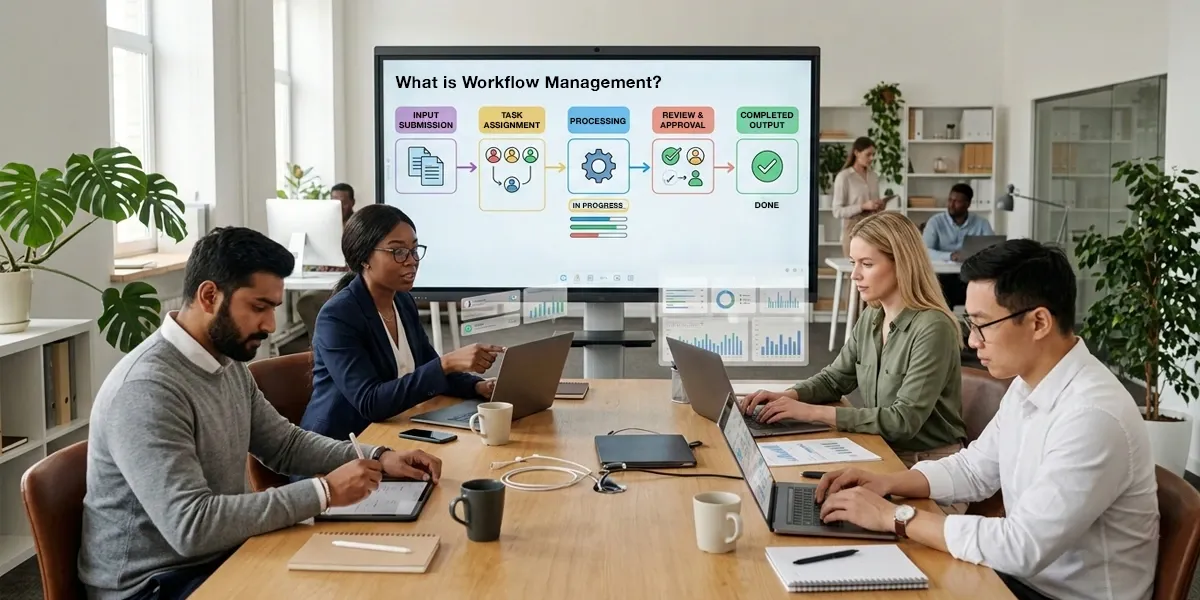
Workflow management refers to the methodical coordination of recurrent patterns of actions, facilitated by structuring of resources, roles, and information into a specified process. In its most basic form it is the technical art of getting the right data to the right entity (human or machine) at the right time under the predefined business logic.
It is paramount to note that workflow management should not be confused with associated fields:
- Project Management: Unique and non-repetitive objectives that have start and end dates.
- Task Tracking: Concentrated on individual work elements without paying much attention to the systemic requirements.
- Workflow Management: This is concerned with optimization of repetitive normal processes to make them predictable, scalable and auditable.
A complex workflow of management systems in the age of digital transformation is the connective tissue between different software resources of a firm so that automated events in an ERP system can automatically trigger an action in a CRM or a tailor-made artificial intelligence engine.
Core Components of Workflow Management
A robust enterprise workflow design has five major pillars:
- Process Modeling: The logical definition of the process with the help of standardized workflow models, like BPMN 2.0. This is related to mapping all decision nodes, tasks and actors that participate in the process lifecycle.
- Task Orchestration: The engine which controls the hand-offs between various steps of the working process, where dependencies are required before marching on.
- Role-Based Execution: Disposition of duties according to organizational structure or professionalism, which provides security and extensive compliance through rigid access management.
- Automation Logic: It can be based on the integration of If-This-Then-That (IFTTT) triggers or more complex branching logic, which removes human intervention in common data routing.
- Monitoring and Telemetry: View the health of the process in real-time, so that the leaders can see which latency or failure has happened.
Workflow Management Systems Architecture
workflow management systems architecture determines the technical sophistication of the workflows. The complexities of the modern systems have been developed out of the simple linear scripts, into high-availability and distributed environments.
The Workflow Engine
The central point of the system is the engine. It interprets definitions of processes, maintains the state of running instances as well as carries out transitions. These engines should be stateless and horizontally scalable in the context of high-concurrency.
Intelligent Workflows vs. Rules-Based
The enterprise solutions of the modern era incorporate machine learning models where traditional systems utilize hard coded rules to operate. Even these smart workflows are capable of anticipating possible delays, giving the best routing recommendations, and even acting upon exceptions autonomously, leveraging a workflow management systems informed by past data trends.
API Integration and Data Pipelines
There can be no workflow management systems existing in a vacuum. It must have a strong API integration layer to interface with the legacy systems and microservices that are cloud-native. The data should move in both directions, whereby the workflow state should be regularly updated in line with the real system of record.
Types of Workflow Management Systems
The special logic of the workflow system is determined by enterprise requirements:
- Sequential Workflows: Linear stages in which step B can only start when step A is finished (e.g. traditional expense approval).
- Parallel Workflows: Multiple activities run in parallel, and usually a node of a join is needed to coordinate the work before the last one.
- State-Machine Driven Processes: Complicated processes which alternate between states in response to external events or circumstances, and not an ordered sequence.
- Event-Driven Workflows: Asynchronous workflows that occur in response to certain changes in the data or system events, that are typically used in IoT and the logistics of real time.
Technology Enablement for Workflow Management
The world is moving at a fast pace in terms of adoption of workflow management. Industry research suggests that by 2030 the market of automating workflows across the globe will rank higher than 30 billion dollars due to a scramble to seek efficiency in operations. Businesses that have planned the implementation of AI process orchestration claim productivity increases of 20 to 35 percent, especially with the integration of Robotic Process Automation (RPA) into existing workflow management systems.
Orchestration tools (e.g. AWS Step Functions or operators on Kubernetes) that are cloud-native enable companies to operate workflows within hybrid clouds. These systems can be used to give a pane of glass view to all operational logic when combined with ERP and DevOps pipelines.
Implementation Strategy
Effective deployment is a process that involves a stringent, staged one:
- Workflow Evaluation: Assess the current processes in order to find out high-volume and high-error-rate jobs.
- Bottleneck Analysis: Use process mining software to discover the places of work stagnation.
- Selection of a tool: Compare platforms per integration functionality, scalability, and compliance standards (SOC2, GDPR).
- Governance Alignment: Indicate ownership and audit trails to make the automated system adherent to the regulations internal and external.
Key Performance Metrics
In order to measure the ROI of a workflow management systems, organizations will need to follow certain KPIs:
- Cycle Time: The sum of time between the start and the end of a process.
- Throughput: The amount of workflows that are handled in a given period of time.
- SLA Compliance: The rate of completion of the workflows within the agreed time constraints.
- Resource Utilization: The effectiveness of human and compute resources utilization.
Strategic Outlook
Workflow management is becoming Autonomous Enterprise Orchestration (as we look ahead to 2026 and beyond). The transition from fixed rules to agentic AI implies that future workflow management systems will be self-mending and self-optimizing. AI will not simply be performed, it will be dynamically re-designed according to the real-time market changes or resource limitations.
To the contemporary organization, the ability to control workflow is what separates the disjointed organization to a streamlined, fast-paced digital machine.
You Might Also Like